
What If the Most Important Battery Warning Is the One You Haven’t Received Yet?
A battery doesn’t catch fire suddenly. It loses an argument with physics, one degree at a time.
Battery failures can originate from internal faults, electrochemical reactions and abnormal heat generation long before visible flames appear. As electric vehicles (EVs) and battery energy storage systems (BESS) become more widespread, identifying these risks early is critical.
The challenge is not simply detecting when a battery becomes too hot. It is understanding why heat is building up, how the battery’s behaviour is changing and what those changes could indicate. By combining physics-based thermal modelling, electrochemical modelling and AI-driven prediction, SimLionics helps engineering teams investigate abnormal battery behaviour and assess developing thermal risks.
What Causes Battery Fires and Thermal Runaway?
Thermal runaway is a self-accelerating process in which heat generation inside a battery cell exceeds its ability to dissipate that heat. Rising temperatures can accelerate chemical reactions, releasing additional heat and potentially flammable gases.
Contributing factors include internal short circuits, overcharging, external heating, mechanical damage and battery degradation. These can compromise cell stability, increase internal heat generation or reduce thermal safety margins.
Once thermal runaway begins, heat can spread to neighbouring cells, potentially triggering a cascading failure across the battery pack. Understanding these risks requires more than measuring temperature. Engineers must examine how heat is generated, transferred and dissipated under changing operating conditions.
The Physics Behind Thermal Runaway
A battery continuously generates and dissipates heat during operation and its thermal stability depends on the balance between the two. At its most basic level, this balance is described by the fundamental thermal energy equation:
∂(ρcT)/∂t = ∇·(λ∇T) + q − (hA/V)(T − T∞)
Put simply, the change in a cell’s temperature depends on how heat spreads through it, how much heat it generates internally (q) and how much it loses to the surrounding air or coolant. When heat removal keeps pace with generation, the temperature stays stable. When generation wins, temperatures rise, accelerating reactions such as SEI breakdown and electrolyte decomposition that release even more heat. This feedback loop is what drives thermal runaway.
This equation is the starting point, not the full picture. In a real battery, (q) changes with current, state of charge, ageing and local electrochemical conditions, while cooling performance shifts with coolant flow, contact resistance and pack design. At SimLionics, we build on this foundation by coupling it with electrochemical, degradation and geometry-resolved thermal models, so that heat generation is calculated from what is actually happening inside the cell rather than assumed. This is why our models can capture how a battery that was safe when new may behave very differently after thousands of cycles.
Why Battery Risks Can Go Undetected
A conventional battery management system (BMS) monitors parameters such as voltage, current and temperature. However, sensors measure conditions at specific locations, meaning localised hotspots or developing faults may not immediately appear in the available readings.
Fixed thresholds can trigger alerts when predefined limits are crossed, but they may not explain why a battery is behaving abnormally or whether its thermal response differs from what physics predicts. This creates a gap between monitoring present conditions and understanding developing risks. Engineers need to recognise when battery behaviour deviates from expected physical and electrochemical patterns.
How Thermal Modelling Reveals Hidden Risks
Battery thermal modelling uses mathematical representations of heat generation and transfer to estimate temperature distributions across cells and packs. By accounting for cell geometry, material properties, electrical loads and cooling conditions, engineers can:
- Identify potential hotspots: Investigate localised thermal stress that individual sensors may not capture.
- Evaluate heat dissipation: Assess whether cooling performance can keep pace with heat generation.
- Test operating conditions: Examine how changes in load and ambient temperature influence thermal behaviour.
- Analyse thermal propagation: Investigate how heat could spread between cells under fault conditions.
Model accuracy depends on input data, validation and the physical processes represented. Thermal modelling supports risk assessment; it cannot guarantee that every failure will be predicted.
From Physics to Predictive Battery Intelligence
Thermal models explain how heat moves, while electrochemical models help explain where it originates. They represent processes such as reaction kinetics, degradation and changes in heat generation as a battery ages. AI-driven anomaly detection adds another layer by identifying deviations between expected and observed battery behaviour.
For example, if a cell generates more heat than expected under comparable operating conditions, the deviation could indicate a cooling issue, degradation-related changes or another developing fault. Investigating it alongside voltage, current and temperature trends can help engineers prioritise diagnostics.
An anomaly does not automatically indicate impending thermal runaway. Its significance depends on data quality, operating context and supporting evidence. However, identifying unusual behaviour can provide an opportunity for further investigation before conditions deteriorate.
How SimLionics Connects Physics, Electrochemistry and AI
SimLionics brings together three complementary capabilities:
Physics: Models heat conduction and convection across cell and pack geometries to investigate hotspots and cooling performance.
Electrochemistry: Examines reaction kinetics, degradation and the processes influencing internal heat generation as cells age.
AI: Uses operational data alongside model-based insights to support predictions of future thermal and health states.
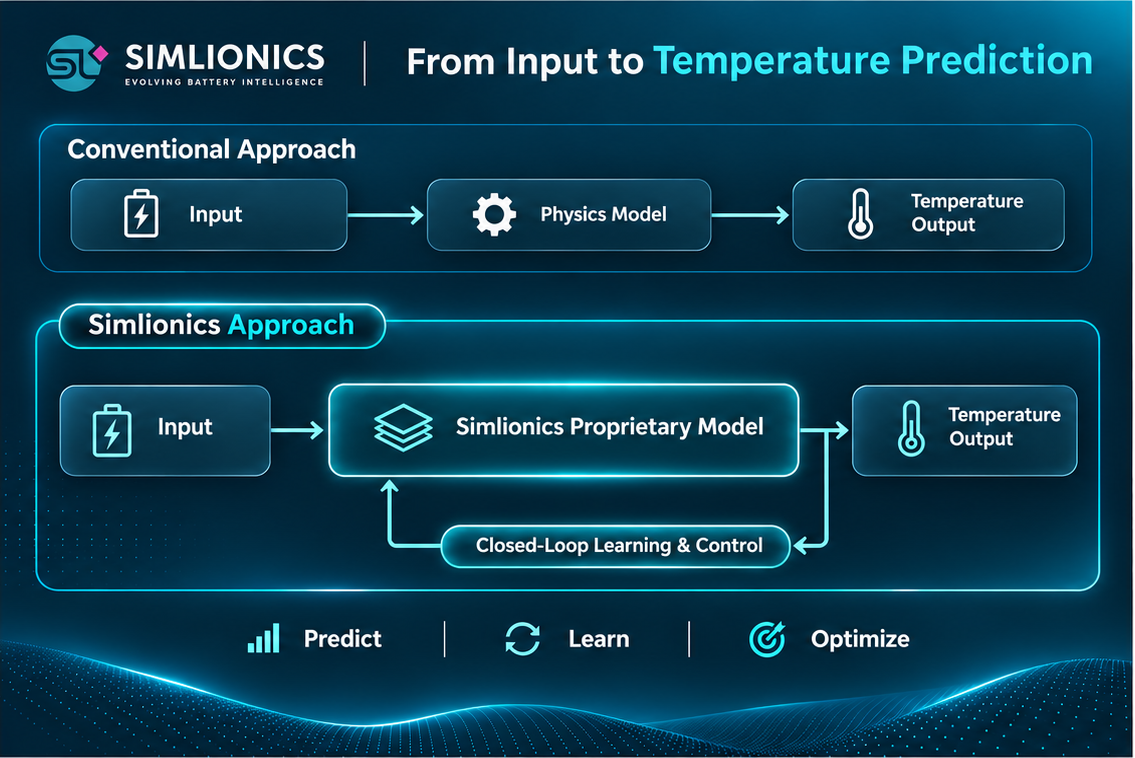
Together, these capabilities connect physical understanding with data-driven prediction. The approach supports a progression from current or power input through physics and electrochemical modelling to AI-driven temperature prediction, with feedback informing further assessment and optimisation.
A typical BMS asks: “Is it too hot right now?” SimLionics asks: “Where is this cell heading, and what should we change today to keep it safe?” The distinction is between observing a battery’s current condition and understanding its likely trajectory to support better-informed engineering decisions.
As battery applications scale, understanding the science behind abnormal battery behaviour is key to staying ahead of potential risks.Discover how SimLionics is advancing a more proactive approach to battery safety through intelligent, physics-led insights.